
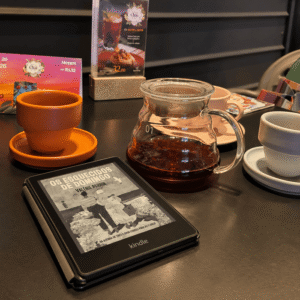

I’ve always heard that people who read are more interesting. I’m not sure where I got this idea, but I think it shaped my relationship with reading. Looking back, I realize that whenever I tried to read, it was usually because I wanted to seem cooler or because I felt I was supposed to.
I wanted to be a reader. But I’m not sure I actually enjoyed reading.
I Was Reading, But Was I Really Enjoying It?
When I was younger, I mostly read books assigned at school. Later, when I became more involved in church, I started reading religious books. There were times when I read quite a lot, but I never developed a consistent reading routine.
I also remember feeling a little embarrassed when people outside the church asked what I was reading. Somehow, I didn’t always feel comfortable sharing it.
Over the years, I bought plenty of books. I’d start one, read a few chapters, and eventually leave it unfinished. Looking back, I think I often chose books because other people said they were good or because they seemed like the kind of books a reader should enjoy not necessarily because I was genuinely interested in them.
I wanted to enjoy reading, but I wasn’t sure how to find books that made me want to keep turning the pages.
Trying to Turn Reading Into a Habit
A few years ago, I tried to build a reading habit. I even participated in 21-day challenges, hoping that reading every day for a few weeks would make it part of my routine.
Sometimes, I completed the challenge. But once it was over, I’d go weeks or even months without picking up a book.
Last year, I listened to Atomic Habits by James Clear. One idea that stuck with me was that small improvements, repeated consistently, can compound over time. The book illustrates this with the idea of getting 1% better every day.
I wanted to apply that principle to my own life, so I started building daily habits. My routine included meditation, prayer, reading, and exercise. I thought that if I repeated these activities often enough, they would eventually become automatic.
But instead of feeling natural, my routine started to feel stressful. Reading became another task to complete rather than something I could enjoy. And whenever my routine or environment changed, I struggled to maintain those habits.
I was so focused on being consistent that I wasn’t paying enough attention to how those activities actually made me feel.
What Changed?
This year, I went through a difficult period in my life. I reached a point where very little seemed to make sense, and I realized I wasn’t doing many things simply because I wanted to. I wasn’t sure what I genuinely enjoyed anymore.
After months without reading, the first thing that came to mind was to pick up my Kindle and start again.
Around the same time, I thought about a friend who absolutely loves reading. She had invited me to join her book club several times, but I always felt a little embarrassed about going, so I kept putting it off.
This time, I said yes.
Having a friend to read with made a difference. She recommended books, and I had an opportunity to discover stories and ideas I might never have chosen on my own.
More importantly, I began to approach reading differently. Instead of trying to become the kind of person I thought a reader should be, I started exploring what I actually liked.
Discovering Books I Actually Enjoyed
I started with personal development books, a subject I’ve always been interested in. One of the first books I genuinely enjoyed was The Knight in Rusty Armor, a fable I finished in a single day.
Then I began exploring fiction through recommendations from the book club. For a long time, I had thought fiction wasn’t for me. I used to believe it was better to read books that could teach me something useful.
That changed when I read Forgotten on Sunday by Valérie Perrin. The story was so engaging that I found myself thinking about it throughout the day, wanting to know what would happen next.
Later, during an English conversation class, I mentioned that I didn’t really like fiction. Someone recommended The Midnight Library by Matt Haig.
I decided to give it a try in English and I loved it. I became so immersed in the story that I didn’t want to stop reading.
I’ve come to realize that fiction can teach us a lot, too. Sometimes, stories help us understand people, see the world from different perspectives, and learn things we might never discover in a nonfiction book.
These experiences helped me realize that perhaps I hadn’t disliked reading as much as I’d thought. Maybe I just hadn’t found the right books for me.
Reading Became Something I Wanted to Do
A few months ago, reading started to feel different. It was no longer something I thought I should do. It became something I genuinely wanted to do.
I started feeling curious about books again. I wanted to discover new authors, explore different ideas, and find out what would happen next in a story.
Eventually, I developed a routine of reading a little every day. Now, when I go a few days without reading, I actually miss it. I even challenge myself to read more not because I feel obligated to, but because I’m enjoying the experience.
Recently, I also started reading in French and Spanish. I’m not expecting to understand every word or read as quickly as I do in English or Portuguese. I’m simply allowing myself to try something new and enjoy the process of learning.
I’m still an analytical person. I count how many pages I read each day and how many books I finish each month. The difference is that these numbers no longer make me feel like I’m failing when I don’t meet a target. Now, they can encourage me and help me see my progress.
I Didn’t Need to Become a Different Person
For a long time, I thought becoming a reader meant developing enough discipline to make reading a habit.
Now, I think it also means giving yourself the freedom to discover what you genuinely enjoy.
I don’t need to read every day just to prove that I’m disciplined. I don’t need to finish a book I’m not enjoying or choose a popular title just because everyone else is reading it. And I don’t need to turn every interest into another productivity goal.
If I’m not in the mood to read, I give myself permission not to. Reading doesn’t have to be another task on my to-do list.
I’m still the same person who likes to organize things, track progress, and set goals. But I’ve learned that not everything I enjoy needs to be measured or optimized.
I didn’t need to become someone who reads. I needed to discover what makes reading enjoyable for me.